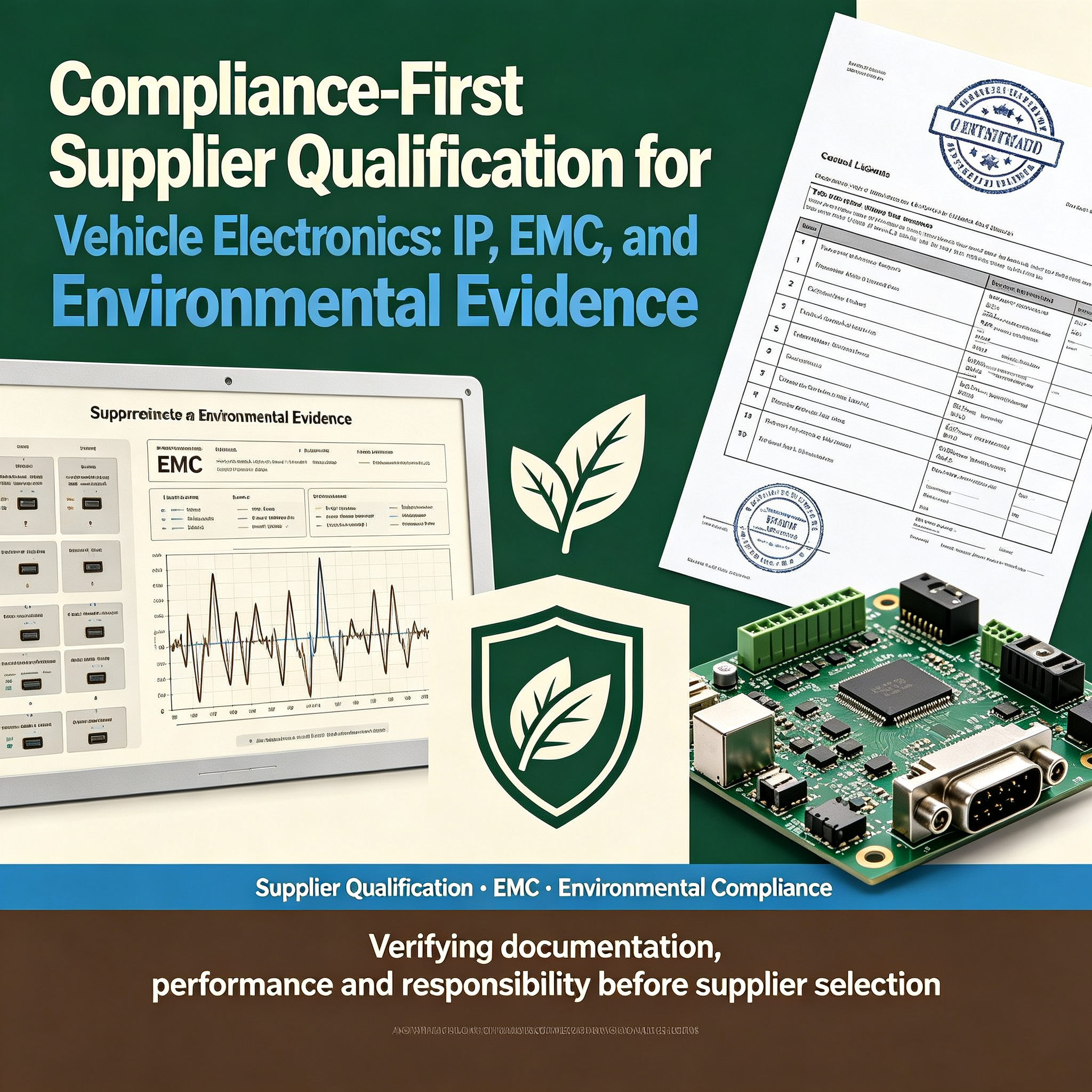
Compliance-First Supplier Qualification for Vehicle Electronics: IP, EMC, and Environmental Evidence
Compliance should be treated as a sourcing gate, not as paperwork collected after nomination. A disciplined Automotive Electronics Supplier Evaluation connects regulatory, OEM, and program requirements to the controls used in B2B Automotive Electronics Procurement. Buyers should translate Vehicle Electronics Quality Standards into explicit evidence for the required Automotive Electronics IP Rating, Automotive Electronics EMC Compliance, Automotive Electronics Temperature Testing, Automotive Electronics MTBF Testing, and Automotive Electronics Aging Test before commercial selection.
1. Build a requirement-to-evidence map
Define the exact configuration under evaluation
The Automotive Electronics Supplier Evaluation file should identify hardware revision, software version, enclosure, connector set, harness assumptions, power profile, and installation environment. This prevents a common sourcing failure: approving a supplier based on a report for a similar but not identical unit. Each requirement should point to a test method, sample configuration, laboratory record, acceptance criterion, and responsible owner.
Separate mandatory gates from engineering preferences
In B2B Automotive Electronics Procurement, teams should distinguish regulatory obligations, customer-specific requirements, safety-critical limits, and negotiable design preferences. Vehicle Electronics Quality Standards become actionable when every item has a clear pass condition and documented deviation route. This also improves supplier comparisons because every bidder is judged against the same controlled baseline.
2. Verify ingress protection at assembly level
Test the production-intent sealing system
An Automotive Electronics IP Rating depends on the complete sealing architecture: housing, gasket, fasteners, vents, connectors, cable interfaces, coatings, and assembly torque. Buyers should request reports for the exact production-intent configuration and review whether preconditioning, thermal exposure, pressure change, or repeated mating could alter performance. The supplier should explain how sealing-critical process parameters are monitored in production.
Connect test results to ongoing control
Qualification is incomplete if the supplier cannot maintain the tested condition. Audit seal inspection, leak testing, torque controls, adhesive cure, gasket storage, connector handling, and change notification. A qualified design can still fail in the field when process variation is not contained.
3. Treat EMC as a system-integration discipline
Review operating modes and worst-case conditions
Automotive Electronics EMC Compliance should cover the operating modes most likely to produce emissions or expose susceptibility, including boot, communication, display brightness, wireless transmission, motor or switching loads, and degraded supply conditions. The test setup should reflect representative harness lengths, grounding, shielding, loads, and software states rather than an artificially favorable laboratory configuration.
Manage retest triggers
A strong compliance process defines when component, PCB, power-conversion, connector, shielding, cable, enclosure, or firmware changes require technical review. The same principle applies to Automotive Electronics Temperature Testing: a material or thermal-path change may invalidate previous results. Buyers should insist on a controlled decision trail rather than informal engineering judgment.
4. Link compliance to reliability and sourcing risk
Cross-check reliability assumptions
Automotive Electronics MTBF Testing should not be isolated from environmental and compliance evidence. If the mission profile includes high heat, thermal cycling, vibration, moisture, or electrical transients, the reliability model should reflect those stressors. Likewise, an Automotive Electronics Aging Test should be designed around known failure mechanisms and production variation rather than a generic time-at-temperature recipe.
Make evidence contractual
A final Automotive Electronics Supplier Evaluation should confirm that compliance evidence is retained, revision-controlled, and available for customer review. In B2B Automotive Electronics Procurement, the contract should preserve required Vehicle Electronics Quality Standards, the approved Automotive Electronics IP Rating, Automotive Electronics EMC Compliance, Automotive Electronics Temperature Testing, Automotive Electronics MTBF Testing, and Automotive Electronics Aging Test as controlled deliverables. The underlined next step is reliability validation plan, which translates compliance findings into stress profiles, sample plans, acceptance criteria, and failure-analysis actions.