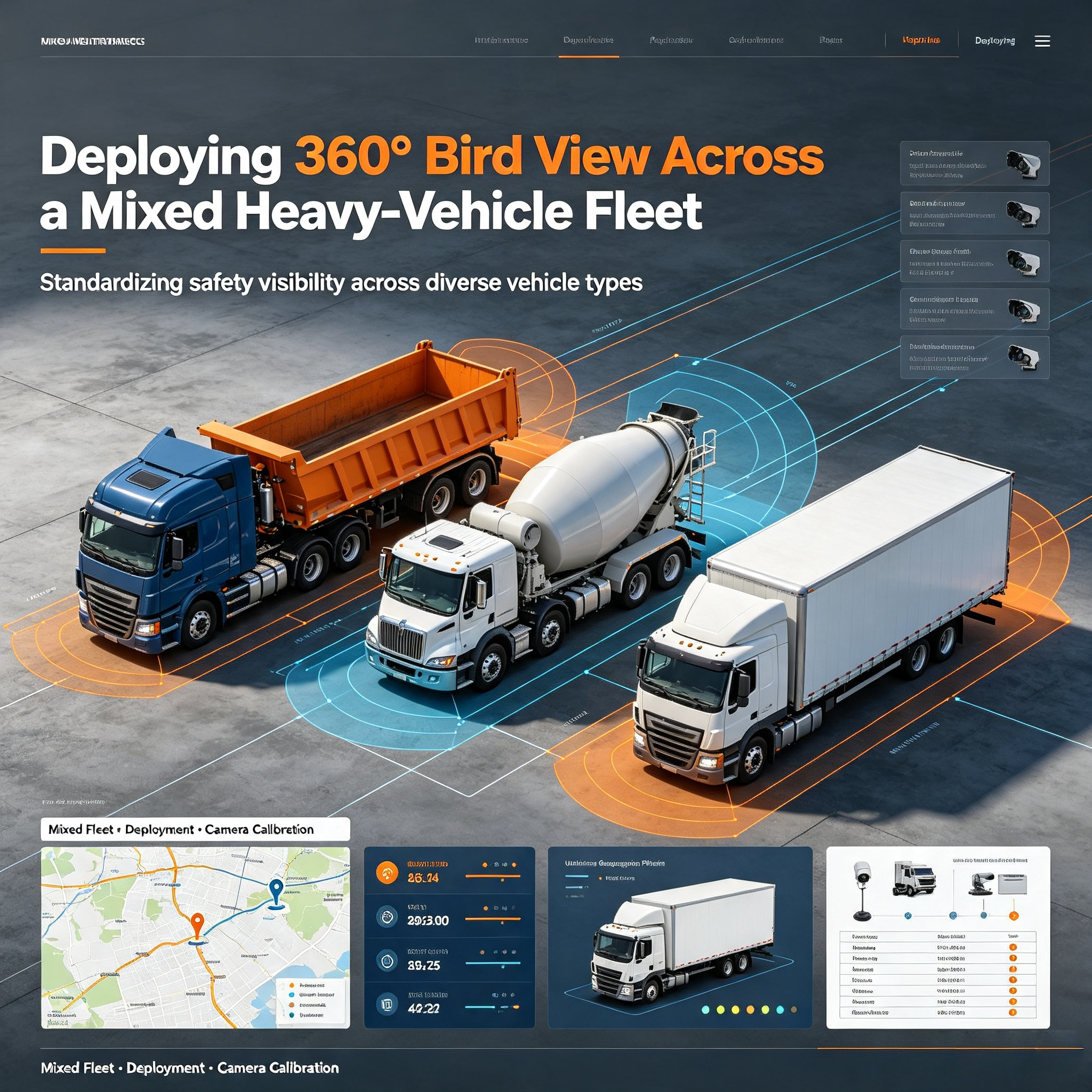
Deploying 360° Bird View Across a Mixed Heavy-Vehicle Fleet
A surround-view project succeeds when technology is integrated with driver behavior, maintenance and measurable operating controls. This deployment guide covers pilot selection, installation standards, training, acceptance testing and fleet-wide rollout for mixed commercial vehicle populations.
The deployment model combines 360° Bird View System, Heavy-duty Vehicle, Blind Spot Elimination, Image Stitching, Camera Calibration, Distortion Correction, Night Vision, Fleet Safety, Accident Avoidance, and Return on Investment.
Selecting a Representative Pilot
Choose vehicles that reflect the fleet's major body types, routes and risk conditions. Include experienced drivers, maintenance staff and safety leaders so technical and operational feedback can be reviewed together.
Standardizing Installation
Define camera locations, cable routing, sealing, power protection and display placement for each vehicle class. Record configuration data so future replacements and recalibrations can be completed consistently.
Training and Acceptance
Drivers should understand what the top-down image represents, where seams appear and why direct observation remains necessary. Acceptance testing should confirm image position, startup behavior, night performance and camera cleanliness.
Scaling With Governance
Use pilot evidence to define rollout priorities, service intervals, responsibility matrices and performance dashboards. Expansion should follow risk and operational value rather than a simple vehicle count.
For governance, teams should review 360° Bird View System, Heavy-duty Vehicle, Blind Spot Elimination, Image Stitching, Camera Calibration, Distortion Correction, Night Vision, Fleet Safety, Accident Avoidance, and Return on Investment together rather than as isolated features.