Designing an Integrated Vehicle Solution for Commercial Fleets
来源:
|
作者:Samaeye
|
发布时间 :2026-08-17
|
2 次浏览:
|
🔊 点击朗读正文
❚❚
▶
|
Share:
This article shows how retrofit companies can design coordinated vehicle technology systems instead of installing isolated devices. It covers use-case definition, power and data architecture, physical integration, compatibility control, commissioning, fleet deployment, maintenance planning, and monetization of engineering knowledge. The approach helps commercial vehicle specialists create repeatable solution packages that combine hardware, software, installation, diagnostics, and support around measurable fleet outcomes.
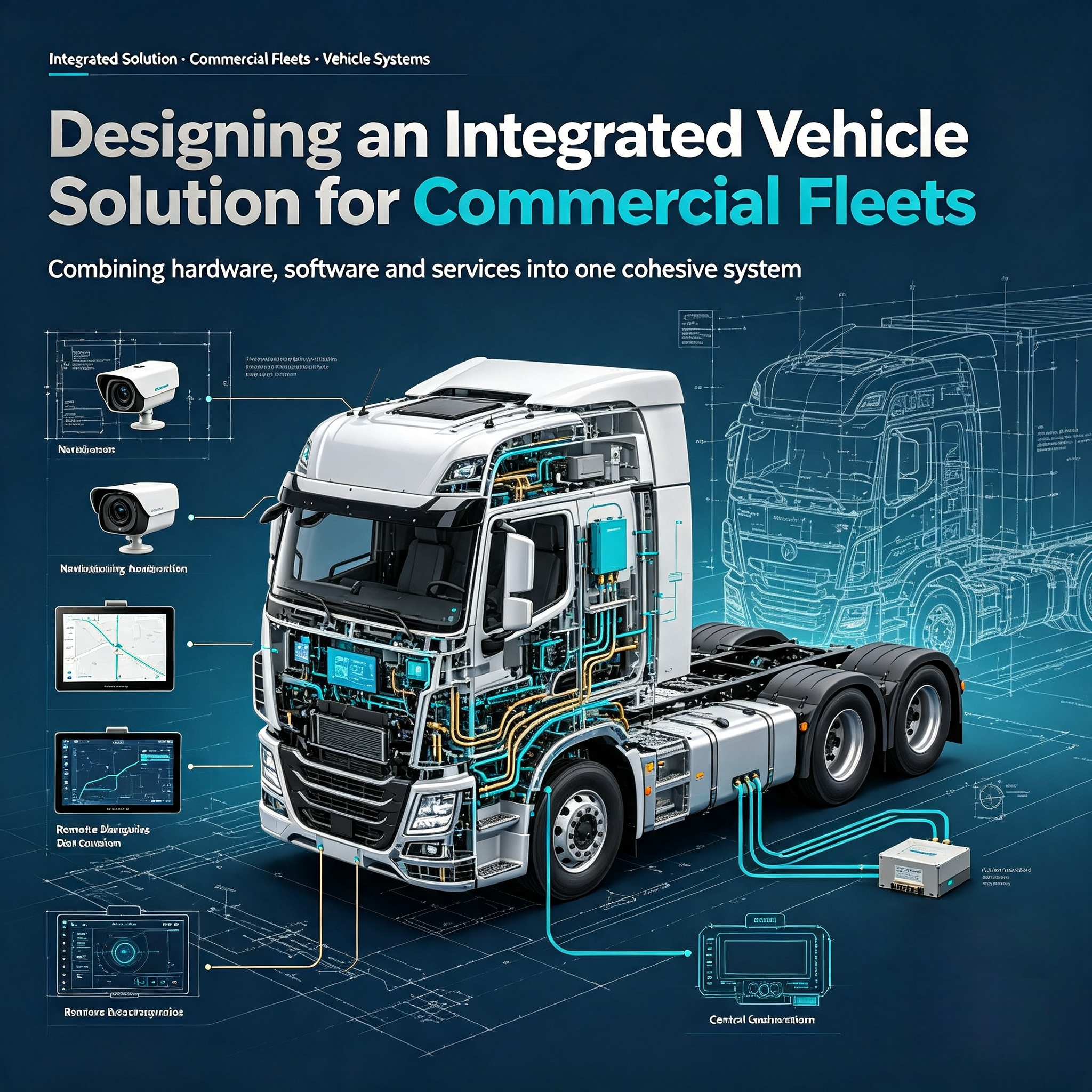
A mature Automotive Refitting Shop does not treat cameras, trackers, sensors, displays, and communication modules as isolated products. Its Business Upgrade Path increasingly depends on designing an Integrated Vehicle Solution in which power, data, mounting, software, diagnostics, and service requirements are planned as one architecture. This capability is central to Solution Provider Transformation because it turns technical integration into a repeatable commercial offer.
1. Begin with vehicle and operating requirements
Map the use case. Identify safety risks, compliance obligations, dispatch needs, visibility gaps, incident evidence requirements, and maintenance constraints.
Map the vehicle. Commercial Vehicle Electronics designs should consider voltage, alternator capacity, ignition states, battery protection, CAN access, bodybuilder connections, and environmental exposure.
Define acceptance criteria. Agree what the system must detect, record, transmit, display, retain, and report before hardware is selected.
2. Engineer the architecture instead of stacking devices
Power architecture. Calculate combined load, startup peaks, standby draw, fuse sizing, grounding strategy, and low-voltage protection.
Data architecture. Decide which devices communicate locally, which send data to the cloud, and how timestamps, vehicle IDs, driver IDs, and events stay synchronized.
Physical architecture. Plan camera fields of view, sensor zones, antenna placement, service access, heat dissipation, vibration resistance, and cable protection.
3. Convert engineering into repeatable delivery
Deployment package. A Standardized Installation Process turns the design into wiring diagrams, mounting drawings, configuration files, inspection forms, and test procedures.
Compatibility control. Maintain an approved vehicle-device matrix to prevent unsupported combinations from reaching the field.
Commissioning. Verify each function individually and then test the complete system under realistic vehicle operating states.
4. Design for fleet operations and lifecycle service
Scale across assets. A Fleet Service Model should support batch provisioning, standard naming, centralized configuration, and fleet-wide reporting.
Plan maintenance. An After-sales Maintenance Service needs remote diagnosis, replaceable modules, spare parts logic, warranty records, and clear escalation paths.
Prove business outcomes. Customer Value Enhancement can be measured through reduced incident cost, lower downtime, improved compliance, faster claims handling, or better utilization.
5. Monetize engineering knowledge
Charge for design. System surveys, architecture, validation, project management, commissioning, and documentation should be visible commercial line items.
Bundle lifecycle value. Profit Model Optimization improves when hardware margin is combined with installation, software, maintenance, training, and service-level revenue.
Create reusable solution modules. Standard packages reduce engineering effort while preserving enough flexibility for different fleet segments.
The next commercial step is to turn integrated projects into repeatable fleet programs. Continue to fleet rollout management to see how project work becomes an ongoing service relationship.
Strategic alignment: The roadmap connects the Business Upgrade Path of an Automotive Refitting Shop with a Standardized Installation Process, an Integrated Vehicle Solution, stronger Commercial Vehicle Electronics capabilities, a scalable Fleet Service Model, a dependable After-sales Maintenance Service, measurable Customer Value Enhancement, disciplined Profit Model Optimization, and the long-term goal of Solution Provider Transformation.