From One-Off Retrofit Jobs to a Repeatable Fleet Service Model
来源:
|
作者:Samaeye
|
发布时间 :2026-08-17
|
1 次浏览:
|
🔊 点击朗读正文
❚❚
▶
|
Share:
This article explains how a retrofit workshop can transform one-off vehicle electronics jobs into a repeatable fleet service business. It covers service tier design, rollout planning, vehicle segmentation, configuration control, program KPIs, capacity planning, lifecycle support, recurring pricing, and account expansion. The model is intended for providers that want more predictable demand, stronger fleet relationships, and a service structure that can scale across sites and vehicle classes.
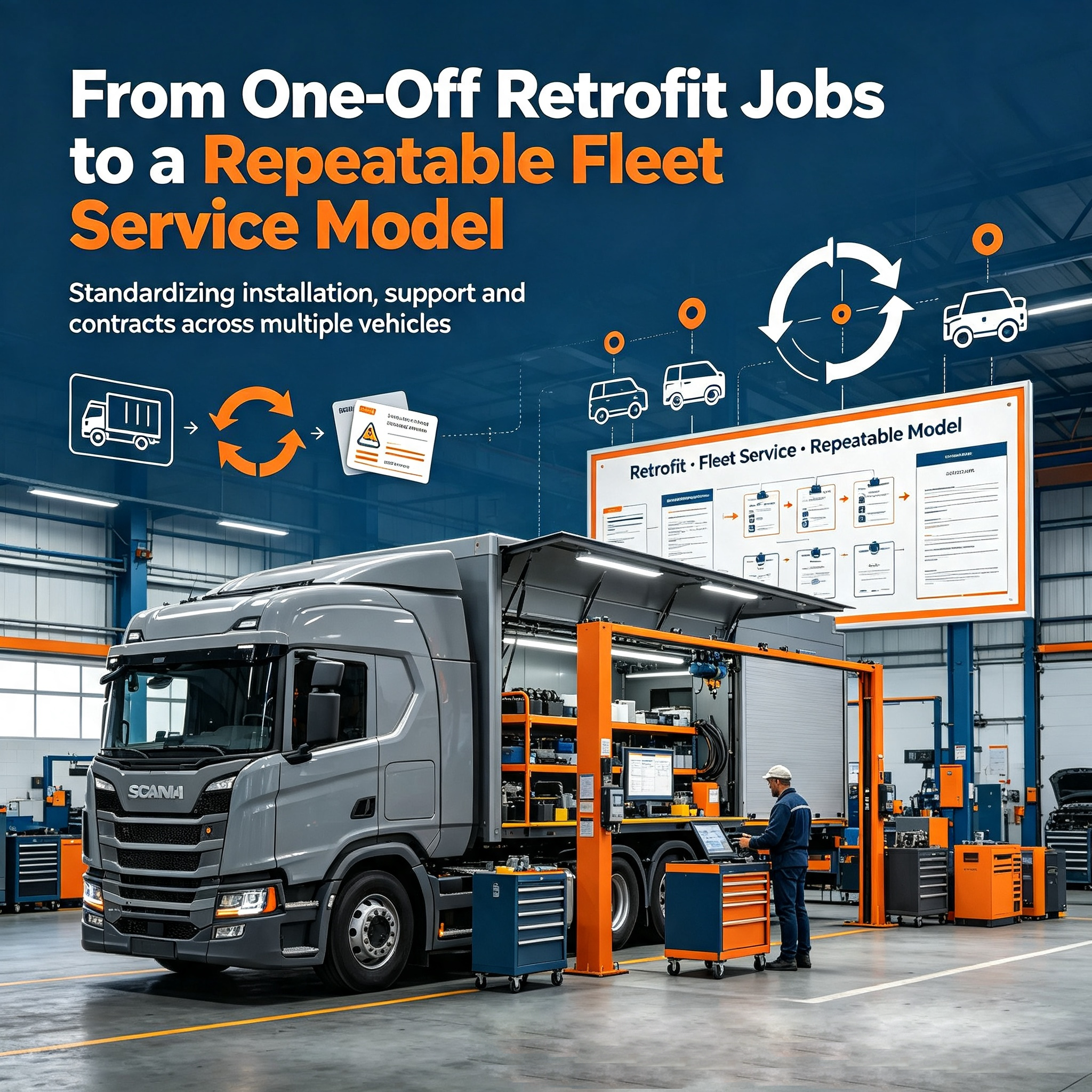
One-off retrofit jobs can generate revenue, but they usually create unstable workloads, inconsistent purchasing, and limited customer retention. The Business Upgrade Path for an Automotive Refitting Shop becomes stronger when integrated project capabilities are packaged into a Fleet Service Model. This move supports Solution Provider Transformation by shifting the relationship from “install these devices” to “keep this fleet’s vehicle technology operating to an agreed standard.”
1. Productize the fleet offer
Define service tiers. Offer clear packages for installation-only, managed deployment, preventive support, full lifecycle service, or multi-site fleet coverage.
Standardize scope. Each package should identify supported vehicle classes, hardware families, installation standards, documentation, response times, and exclusions.
Price the operating burden. Include travel, scheduling, spare stock, remote support, reporting, and project coordination rather than hiding these costs in device margin.
2. Build a rollout engine
Survey the fleet. Group vehicles by model, year, electrical architecture, duty cycle, and depot location.
Use a Standardized Installation Process. This makes cycle time, quality, and training predictable across technicians and sites.
Control configuration. For every Integrated Vehicle Solution, maintain approved hardware, firmware, software settings, wiring revisions, and vehicle-specific exceptions.
3. Operate commercial vehicle programs, not workshop queues
Coordinate stakeholders. Commercial Vehicle Electronics deployments often involve fleet managers, drivers, IT teams, safety teams, procurement, insurers, and vehicle dealers.
Track program KPIs. Monitor vehicles completed, first-time pass rate, defects, downtime, missed appointments, service backlog, and issue closure time.
Plan capacity. Use forecasted fleet schedules to reserve technicians, mobile teams, parts, and depot access.
4. Add lifecycle commitments
Support after deployment. An After-sales Maintenance Service can combine remote troubleshooting, scheduled inspection, warranty handling, field repair, and replacement stock.
Demonstrate outcomes. Customer Value Enhancement comes from predictable uptime, fewer repeat failures, clearer service records, and less administrative work for the fleet.
Build recurring margin. Profit Model Optimization improves through monthly support fees, service-level commitments, preventive maintenance, and standardized replacement pricing.
5. Create account expansion paths
Expand by vehicle group. Prove the model on one depot or vehicle class, then extend to additional assets.
Expand by function. Add cameras, telematics, driver monitoring, sensors, displays, or maintenance analytics as operational needs mature.
Review value quarterly. Use service data and fleet KPIs to identify the next improvement opportunity instead of waiting for a new equipment request.
A fleet contract becomes more defensible when support continues after installation. The next article focuses on preventive maintenance plans and recurring after-sales revenue.
Strategic alignment: The roadmap connects the Business Upgrade Path of an Automotive Refitting Shop with a Standardized Installation Process, an Integrated Vehicle Solution, stronger Commercial Vehicle Electronics capabilities, a scalable Fleet Service Model, a dependable After-sales Maintenance Service, measurable Customer Value Enhancement, disciplined Profit Model Optimization, and the long-term goal of Solution Provider Transformation.