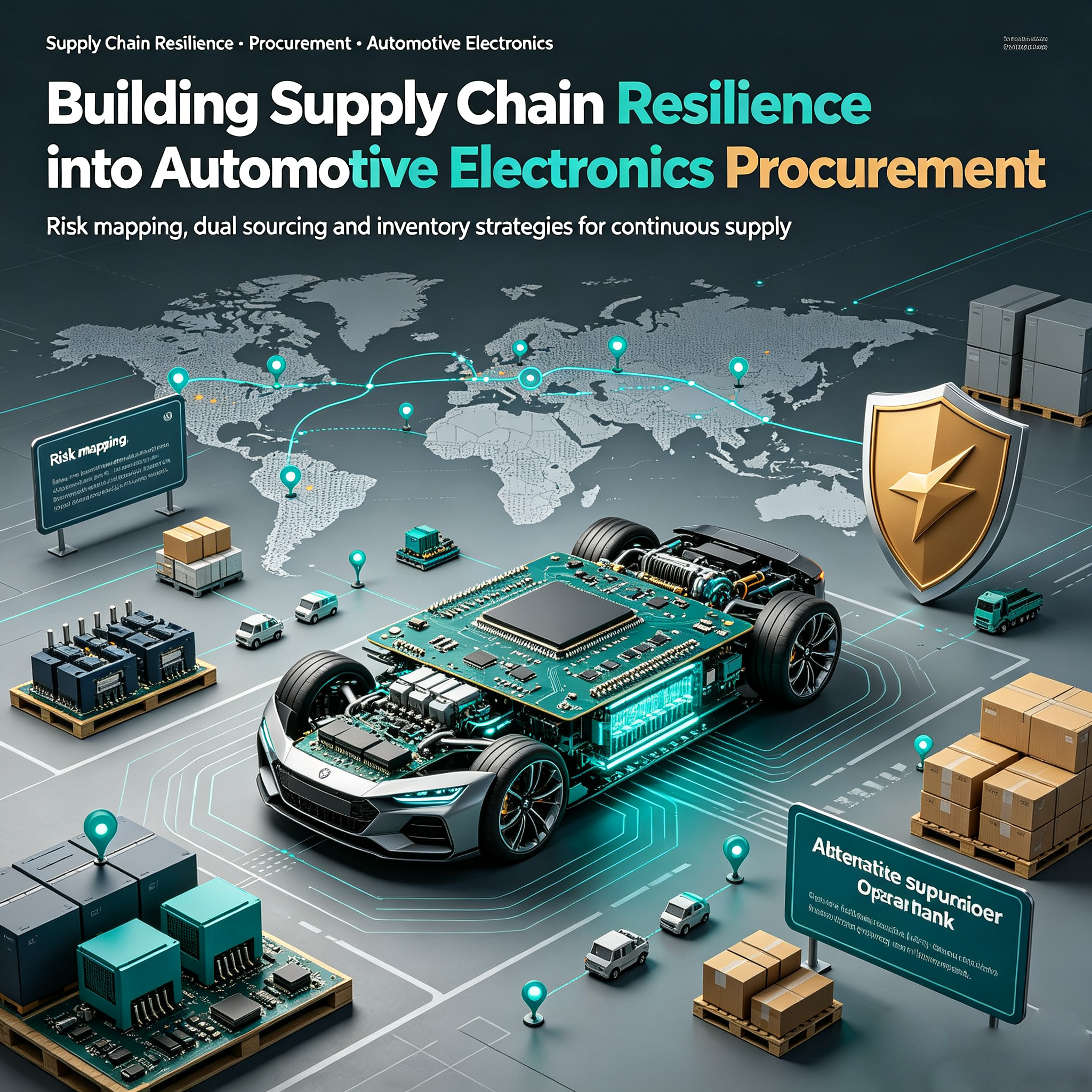
Building Supply Chain Resilience into Automotive Electronics Procurement
Supplier resilience must be evaluated with the same discipline as technical quality. A robust Automotive Electronics Supplier Evaluation for B2B Automotive Electronics Procurement should combine Vehicle Electronics Quality Standards with visibility into capacity, source concentration, obsolescence, logistics, and recovery planning. The technical baseline still matters: the required Automotive Electronics IP Rating, Automotive Electronics EMC Compliance, Automotive Electronics Temperature Testing, Automotive Electronics MTBF Testing, and Automotive Electronics Aging Test must remain protected when alternate materials, sites, or processes are introduced.
1. Map critical dependencies beyond the Tier 1 supplier
Identify single-source and long-lead exposure
The resilience phase of Automotive Electronics Supplier Evaluation should map semiconductors, memory, displays, sensors, connectors, custom mechanical parts, coatings, and specialized test equipment to actual source locations and lead times. Buyers should ask which items are sole-sourced, allocation-prone, custom, or close to end of life. The objective is to reveal where a disruption could stop output even when the final assembler has healthy inventory.
Validate alternate-source governance
For B2B Automotive Electronics Procurement, an alternate is useful only if technical equivalence, capacity, tooling, validation, and commercial terms are understood before a crisis. Vehicle Electronics Quality Standards should define the approval path for alternate components and sites, including documentation, sample submission, requalification scope, customer approval, and traceability. Emergency substitutions without this discipline can convert a supply problem into a quality problem.
2. Test capacity claims against realistic demand scenarios
Measure constrained capacity, not nameplate capacity
Request line-level capacity assumptions, cycle times, yield, uptime, shift model, bottleneck equipment, maintenance plans, labor constraints, and shared-customer demand. Confirm whether burn-in chambers, EMC facilities, environmental chambers, programming stations, and end-of-line testers become bottlenecks at peak volume. Capacity analysis should include ramp-up and recovery, not just steady-state output.
Protect qualification during transfers
If production moves to another line or site, the approved Automotive Electronics IP Rating and Automotive Electronics EMC Compliance cannot be assumed to transfer automatically. Sealing processes, grounding, shielding, fixtures, programming, calibration, and operator methods may differ. Change governance should define what evidence is required before the transferred product can ship.
3. Link resilience actions to technical revalidation
Control environmental and reliability risk after changes
Automotive Electronics Temperature Testing should be reconsidered when thermal-interface materials, PCB suppliers, power components, housings, adhesives, coatings, or assembly processes change. Likewise, Automotive Electronics MTBF Testing assumptions may need revision if component reliability data or duty profiles change. Resilience plans should therefore contain technical checkpoints rather than treating sourcing alternatives as purely commercial decisions.
Use aging evidence to screen transition risk
An Automotive Electronics Aging Test can be valuable after a major component or process change when the risk is early-life instability or latent workmanship defects. Procurement and engineering should agree when accelerated screening, burn-in, or targeted validation is justified, who pays for it, and what release criteria apply. This avoids emergency decisions that bypass the reliability controls used in the original qualification.
4. Contract for recovery capability and transparency
Define continuity obligations
A sourcing decision should consider emergency inventory, tooling ownership, disaster recovery, cybersecurity, utility dependency, logistics alternatives, sub-tier notification, and communication cadence. A final Automotive Electronics Supplier Evaluation can score time-to-recover and time-to-survive for critical nodes. In B2B Automotive Electronics Procurement, this makes resilience measurable and comparable rather than a generic promise in a supplier presentation.
Prevent resilience from eroding quality
Commercial agreements should preserve Vehicle Electronics Quality Standards during shortages and transfers. Any change affecting the required Automotive Electronics IP Rating, Automotive Electronics EMC Compliance, Automotive Electronics Temperature Testing, Automotive Electronics MTBF Testing, or Automotive Electronics Aging Test should follow documented approval and evidence rules. The underlined next step is supplier performance scorecard, which converts quality, compliance, reliability, delivery, cost, and resilience into an ongoing governance system after nomination.