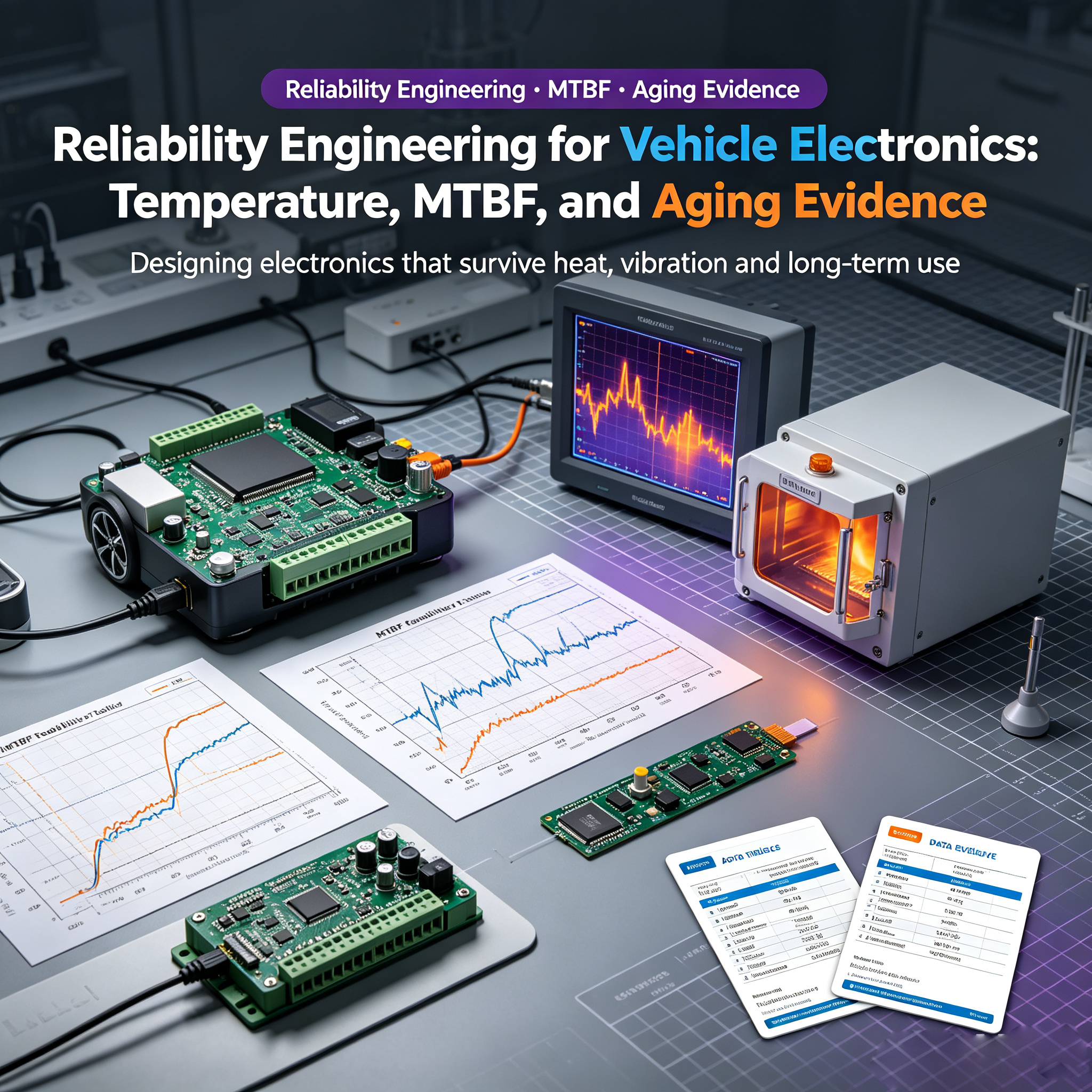
Reliability Engineering for Vehicle Electronics: Temperature, MTBF, and Aging Evidence
Reliability claims should be converted into evidence that reflects the actual vehicle mission profile. A mature Automotive Electronics Supplier Evaluation asks whether the supplier can support B2B Automotive Electronics Procurement with repeatable controls aligned to Vehicle Electronics Quality Standards. That means connecting the required Automotive Electronics IP Rating and Automotive Electronics EMC Compliance to a validation program that includes Automotive Electronics Temperature Testing, defensible Automotive Electronics MTBF Testing, and a targeted Automotive Electronics Aging Test.
1. Translate the vehicle mission profile into test stress
Define real operating states
The reliability portion of an Automotive Electronics Supplier Evaluation should begin with mounting location, ambient and internal temperature, voltage range, duty cycle, communication load, vibration, humidity, contaminants, and expected service life. Buyers should ask how these inputs become test limits and why the selected acceleration factors are technically justified. A laboratory profile that is disconnected from real use can create false confidence even when every sample passes.
Align the plan with sourcing requirements
Within B2B Automotive Electronics Procurement, the reliability plan should be agreed before final nomination so sample quantities, fixtures, test duration, reporting, and revalidation costs are visible in the commercial decision. Vehicle Electronics Quality Standards should state not only the limit but also the evidence format, failure definition, data-retention period, and triggers for repeating validation after a design or process change.
2. Use temperature testing to expose realistic failure mechanisms
Control ramps, dwells, cycles, and power states
Automotive Electronics Temperature Testing should reflect the behavior of components, solder joints, displays, adhesives, seals, batteries, and power electronics at extremes and during transitions. Review ramp rates, dwell time, cold start, hot operation, power cycling, thermal shock, humidity interaction, and electrical loading. Raw data should include actual chamber conditions and device operating states rather than only a final pass statement.
Protect enclosure and EMC performance after stress
Environmental stress may change sealing, connector interfaces, grounding, shielding, or PCB behavior. Therefore, the required Automotive Electronics IP Rating and Automotive Electronics EMC Compliance should be checked against the reliability sequence. Where risk justifies it, repeat relevant ingress or EMC checks after thermal cycling, vibration, or aging to confirm that compliance survives realistic life exposure.
3. Interpret MTBF as a decision tool, not a marketing number
Inspect assumptions and statistical confidence
Automotive Electronics MTBF Testing should document the failure definition, population, accumulated test hours, confidence level, censoring rules, stress conditions, and treatment of repaired or suspended samples. Procurement teams should distinguish prediction based on component models from demonstrated reliability based on observed test data. Each method can be useful, but they answer different questions and should not be presented as interchangeable.
Connect failures to corrective action
A useful Automotive Electronics Aging Test is designed around suspected early-life and wear-out mechanisms. When a failure occurs, the supplier should preserve the failed sample, reproduce the symptom, isolate root cause, identify affected lots, implement containment, and update design or process controls. Reliability evidence is strongest when the organization can show how test failures improved later production rather than simply replacing failed samples.
4. Build a reliability gate into supplier nomination
Score evidence quality and revalidation discipline
A final Automotive Electronics Supplier Evaluation should score the completeness of the validation plan, traceability of samples, laboratory control, raw-data availability, failure analysis, and change-trigger logic. In B2B Automotive Electronics Procurement, these factors can materially affect warranty exposure and line-stop risk. The scorecard should therefore weight demonstrated engineering discipline alongside price and capacity.
Carry reliability obligations into the contract
Contractual Vehicle Electronics Quality Standards should preserve the approved Automotive Electronics IP Rating, Automotive Electronics EMC Compliance, Automotive Electronics Temperature Testing, Automotive Electronics MTBF Testing, and Automotive Electronics Aging Test as revision-controlled deliverables. Retest responsibility, evidence retention, deviation approval, and change notification should be explicit. The underlined next step is supply chain resilience model, because validated hardware still creates business risk if critical materials, capacity, or logistics cannot recover from disruption.