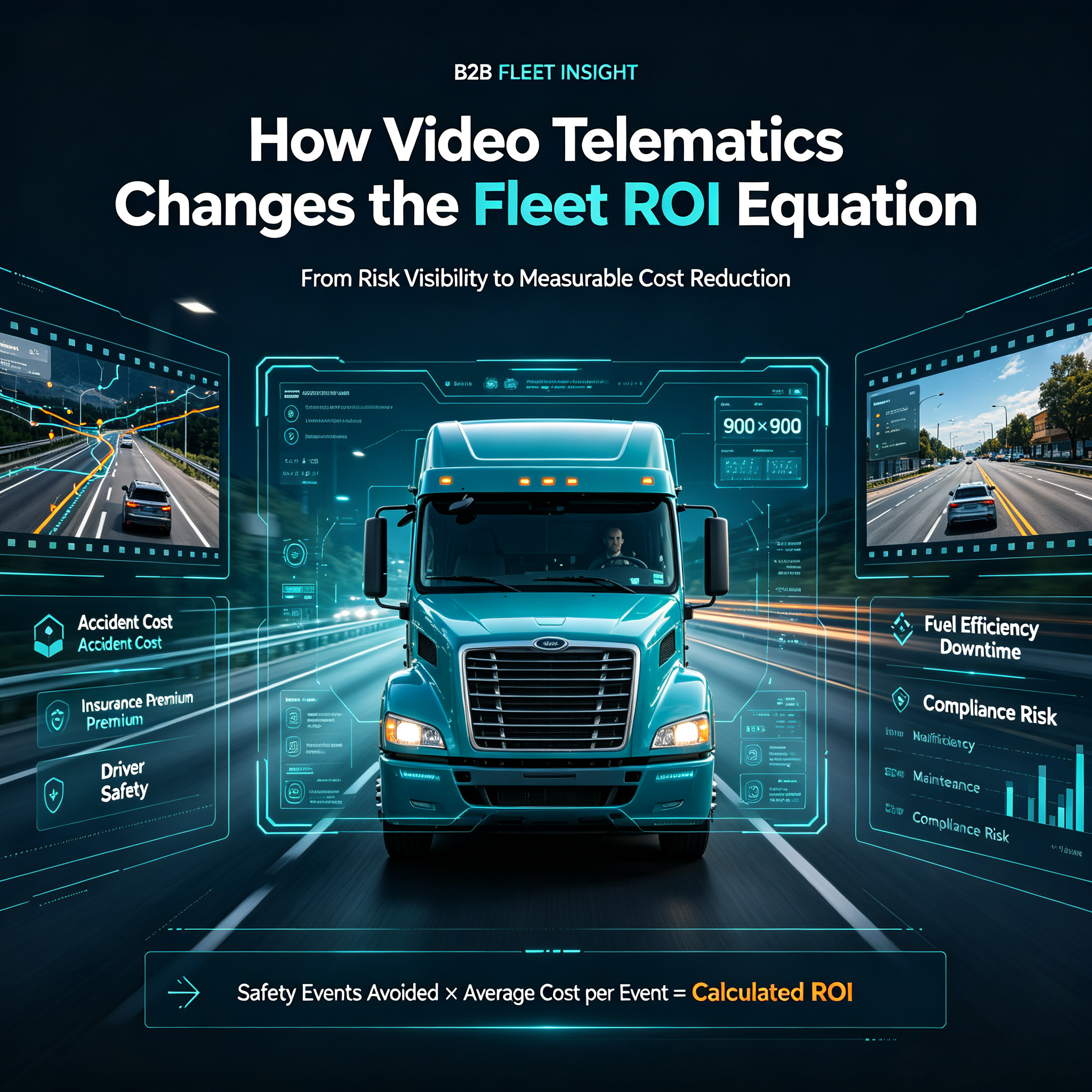
How Video Telematics Changes the Fleet ROI Equation
For many operators, technology investment decisions fail because the financial model focuses only on hardware price. A more accurate approach evaluates how safety, fuel, labor, maintenance, and insurance improvements influence Fleet ROI. When cameras, sensors, and connectivity are integrated, Video Telematics becomes a cost-control platform rather than a standalone recording tool.
1. Start With a Baseline Cost Structure
A useful business case begins with a clear baseline. The operator should calculate annual accident costs, fuel waste, idle time, maintenance spending, claims administration, vehicle downtime, and driver turnover. These figures establish the pre-deployment Fleet TCO and make later savings measurable.
Baseline inputs should include:
Average cost per preventable collision
Insurance deductibles and premium increases
Fuel consumed during excessive idling
Unscheduled repair costs
Administrative time spent reviewing incidents
Revenue lost during vehicle downtime
2. Quantify Safety-Related Savings
AI cameras and event detection can identify distraction, fatigue, tailgating, harsh braking, and unsafe lane changes. These capabilities improve driver coaching and support faster incident investigation. In a strong Fleet Cost Management model, avoided accidents and reduced claim severity are treated as direct financial benefits.
Integrated In-Vehicle Electronics can also preserve evidence, shorten claim resolution, and reduce false liability. This creates value beyond simple accident prevention.
3. Add Fuel and Productivity Improvements
Vehicle Telematics provides visibility into idle time, route deviation, speeding, and inefficient driving. When managers use this information consistently, fuel waste can be reduced and delivery productivity can improve.
A modern Fleet Tracking System also supports dispatching, geofencing, customer updates, and route planning. These functions reduce unnecessary mileage and improve vehicle utilization.
4. Connect Safety Data With Fleet Operations
A Connected Fleet combines video, GPS, diagnostics, and driver records in one platform. This allows managers to compare safety events with maintenance issues, route conditions, and work schedules.
When data is unified, Fleet Analytics can identify which vehicles, drivers, routes, or operating periods create the highest risk and cost. That insight strengthens both daily control and long-term planning.
5. Include Maintenance and Downtime Benefits
Integrated Commercial Vehicle Electronics can capture engine faults, battery health, mileage, and usage patterns. These signals help schedule maintenance before failure and reduce expensive roadside events.
Predictive alerts also support Fleet Optimization by ensuring the right vehicles are available for the right jobs. Lower downtime improves revenue capacity while reducing emergency repair expenses.
6. Build the ROI Formula
A practical annual model can be expressed as:
Annual Net Benefit = Safety Savings + Fuel Savings + Maintenance Savings + Labor Savings + Insurance Savings - Annual Technology Cost
Fleet ROI = Annual Net Benefit ÷ Total Technology Investment
The calculation should include software subscriptions, installation, training, support, replacement hardware, and internal administration. This makes the model more credible for finance teams.
7. Measure Results After Deployment
Successful Fleet Management requires monthly comparison against the original baseline. Managers should track collision frequency, claim severity, idle time, fuel efficiency, repair cost, driver score, and vehicle availability.
When these indicators improve together, the organization can demonstrate that the technology program is producing measurable value rather than isolated operational benefits.
Conclusion
Video systems deliver the strongest return when they are integrated with telematics, diagnostics, analytics, and driver workflows. A complete model connects safety outcomes to operating costs and shows how digital fleet technology improves profitability. By measuring all savings categories, operators can build a defensible investment case and continuously improve performance.