Building Recurring Revenue with After-sales Maintenance Services
来源:
|
作者:Samaeye
|
发布时间 :2026-08-19
|
3 次浏览:
|
🔊 点击朗读正文
❚❚
▶
|
Share:
This article outlines how an automotive electronics provider can build recurring revenue and stronger customer retention through structured after-sales maintenance. It covers preventive inspection, remote diagnostics, field response, asset traceability, spare-parts planning, service KPIs, maintenance packaging, warranty boundaries, and support automation. The framework helps retrofit businesses protect fleet uptime, lower service cost, and turn installation records into a long-term operational advantage.
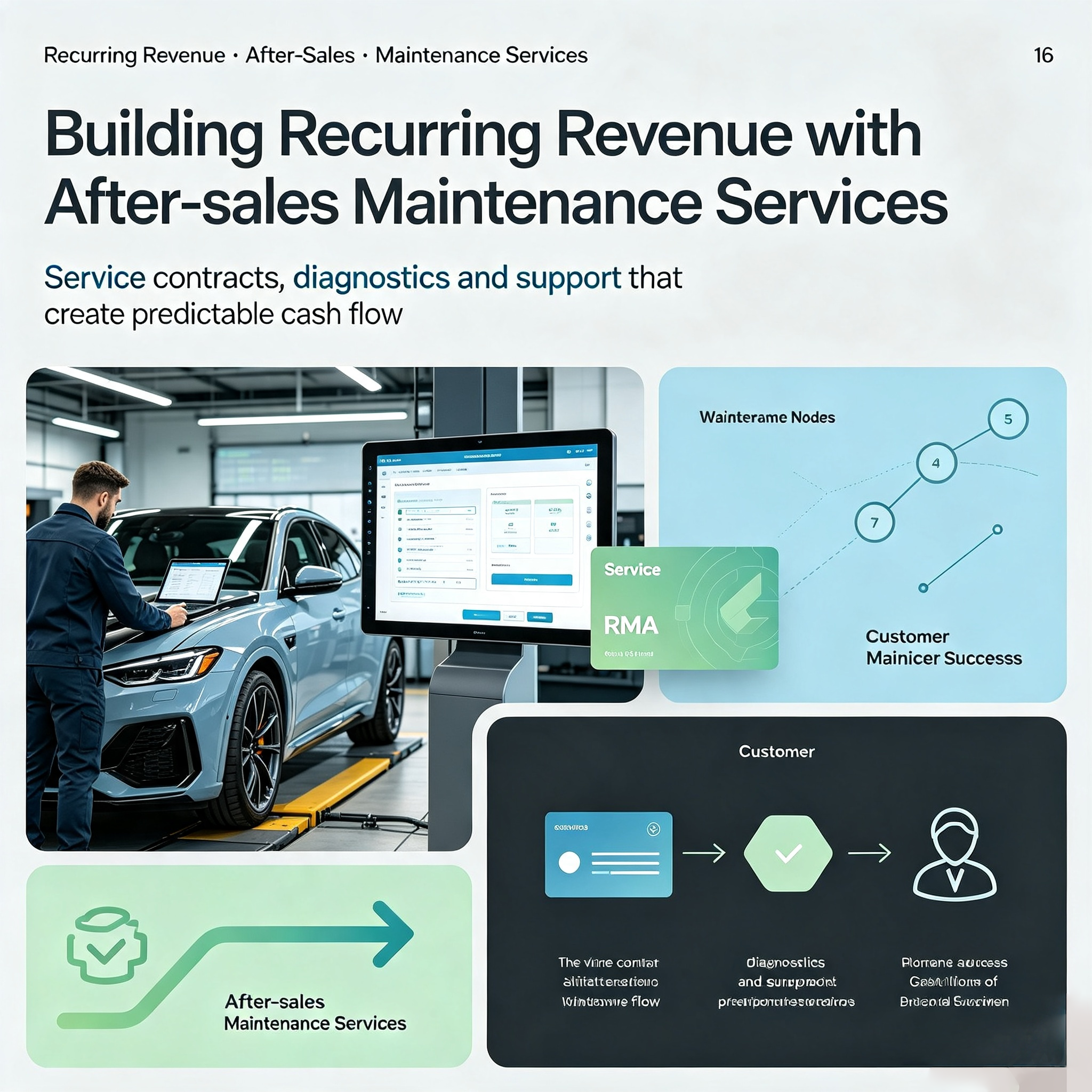
Installation revenue ends when the vehicle leaves the bay, but the customer’s operational risk continues for years. An Automotive Refitting Shop following a durable Business Upgrade Path can turn that gap into an After-sales Maintenance Service that protects uptime, creates recurring revenue, and deepens customer relationships. This service layer is a major step in Solution Provider Transformation because it makes the provider accountable for performance over time rather than only for initial delivery.
1. Define what maintenance actually covers
Preventive inspection. Check connectors, mounting points, lenses, antennas, cables, power circuits, storage media, firmware, and device health before failures occur.
Remote diagnosis. Use device status, logs, connectivity records, and configuration history to distinguish hardware failure from power, network, software, or user issues.
Field response. Set rules for depot visits, mobile repair, replacement units, and escalation when remote support cannot restore service.
2. Use installation data as the service foundation
Preserve traceability. A Standardized Installation Process should produce serial-number records, wiring revisions, photos, test results, and technician history.
Maintain architecture records. Each Integrated Vehicle Solution needs a current bill of materials, configuration baseline, and compatibility record.
Support complex assets. Commercial Vehicle Electronics service becomes faster when technicians can see how multiple devices share power, data, and mounting locations.
3. Package maintenance for fleets
Service by risk level. A Fleet Service Model can offer different response times and inspection frequencies for safety-critical, compliance-critical, or convenience systems.
Hold strategic spares. Use failure rates and fleet size to determine replacement stock instead of carrying excessive inventory.
Report service performance. Track first-time fix rate, mean time to repair, repeat failure rate, device availability, and open cases.
4. Convert support activity into customer value
Reduce downtime. Customer Value Enhancement is strongest when the provider can demonstrate fewer workshop returns, quicker repairs, and higher technology availability.
Improve decision-making. Service records reveal weak components, harsh operating conditions, recurring installation problems, and training gaps.
Use reviews to propose upgrades. Maintenance data can justify selective replacement or additional functionality based on evidence rather than sales pressure.
5. Build a profitable service engine
Choose the right charging model. Profit Model Optimization may use per-vehicle monthly fees, annual service contracts, prepaid service credits, or tiered response packages.
Separate included and chargeable work. Clarify warranty, accidental damage, consumables, travel, after-hours support, and unsupported modifications.
Automate administration. Ticketing, asset records, parts tracking, and scheduled maintenance reminders reduce the cost of managing recurring service.
Recurring service creates the data needed to understand true customer lifetime value and account profitability. The final article moves to service-level profitability and the economics of the full transformation.
Strategic alignment: The roadmap connects the Business Upgrade Path of an Automotive Refitting Shop with a Standardized Installation Process, an Integrated Vehicle Solution, stronger Commercial Vehicle Electronics capabilities, a scalable Fleet Service Model, a dependable After-sales Maintenance Service, measurable Customer Value Enhancement, disciplined Profit Model Optimization, and the long-term goal of Solution Provider Transformation.